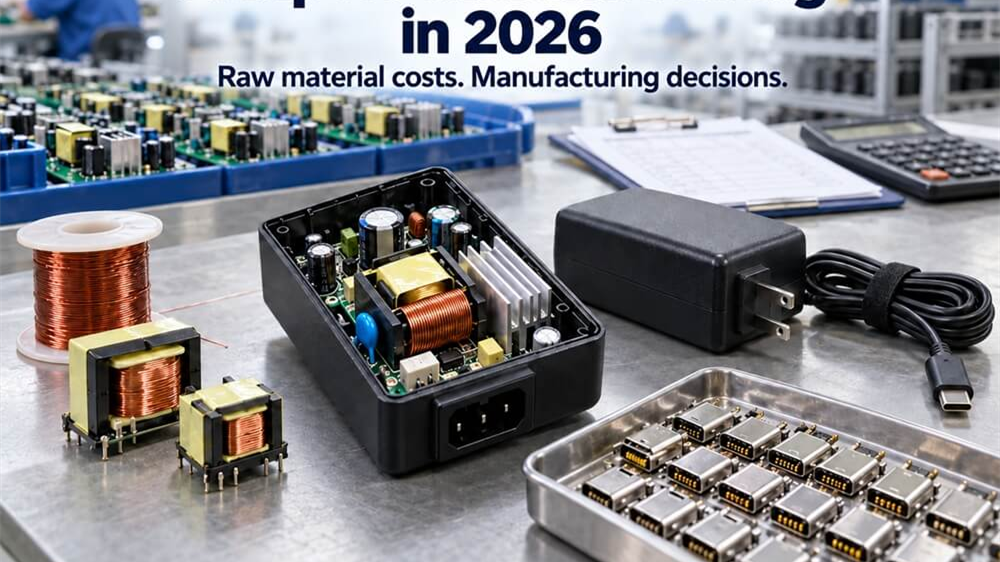
Have you ever wondered why a high-quality original power brick can last a decade while a cheap “knock-off” dies in just six months? While most people focus on the thickness of the plastic shell or the sturdiness of the cable, the true “biological clock” of a power adapter ticks inside its circuit board. Specifically, it is the Aluminum Electrolytic Capacitor.
1. The “Weakest Link” in the Chain
A power adapter is packed with various components: transformers, resistors, transistors, and diodes. Most of these are “solid-state,” meaning they can theoretically last for decades if operated within their specifications. However, electrolytic capacitors are different. They are one of the few electronic components that contain a liquid—known as the electrolyte.
Why Do They Fail?
The death of a power adapter is usually a slow “evaporation” process. Here is how the degradation unfolds:
- Chemical Evaporation: As the adapter operates, it generates heat. This heat causes the liquid electrolyte inside the capacitor to slowly permeate through the rubber seal and evaporate.
- Increased ESR: As the liquid disappears, the capacitor’s Equivalent Series Resistance (ESR) increases. This causes the capacitor to generate even more heat, creating a destructive feedback loop.
- The 10°C Rule: In the world of power electronics, we follow the Arrhenius Law: For every 10°C increase in operating temperature, the lifespan of an electrolytic capacitor is cut in half.
What Happens When the Capacitor Fails?
When a capacitor loses its ability to store and filter energy, you will notice several “symptoms”:
- Voltage Ripple: The power output becomes “dirty” and unstable.
- Device Malfunction: Your laptop or phone might show it is charging, but the touch screen becomes glitchy or unresponsive due to electromagnetic interference.
- The “Click of Death”: The adapter tries to start, fails, and emits a faint clicking or high-pitched whining sound.
2. Solid vs. Liquid: The Longevity Secret
High-end manufacturers (such as those for premium laptops or medical equipment) often combat this issue by using Solid Polymer Capacitors.
| Feature | Electrolytic (Liquid) | Solid Polymer |
| Lifespan | 2,000 – 5,000 hours (at max temp) | 50,000+ hours |
| Heat Resistance | Moderate | Extremely High |
| Failure Mode | Dries out / Leaks / Bulges | Highly stable over time |
3. How to Extend Your Adapter’s Life
Since heat is the primary enemy of the capacitor, you can win the war against time with these three simple tips:
- Prioritize Ventilation: Do not bury your power brick under pillows or behind heavy curtains. Let it “breathe” to dissipate heat.
- Unplug When Not in Use: Even when not charging a device, a plugged-in adapter consumes “vampire power,” which keeps the internal capacitors warm and aging.
- Quality Matters: Cheap adapters use capacitors rated for 85°C. Better ones use 105°C rated components, which significantly boosts overall durability.
Conclusion
In the world of electronics, a device is only as strong as its most vulnerable part. While silicon chips and copper coils can endure for ages, the liquid electrolyte inside a capacitor is a finite resource. By understanding that heat is the “accelerant” for this evaporation, you can significantly extend the life of your hardware through better placement and mindful usage habits.
The next time your power adapter dies, don’t just blame the cable. It is highly likely that a tiny cylinder of liquid inside finally “ran dry.” In the race against time, the capacitor is the one component destined to lose.