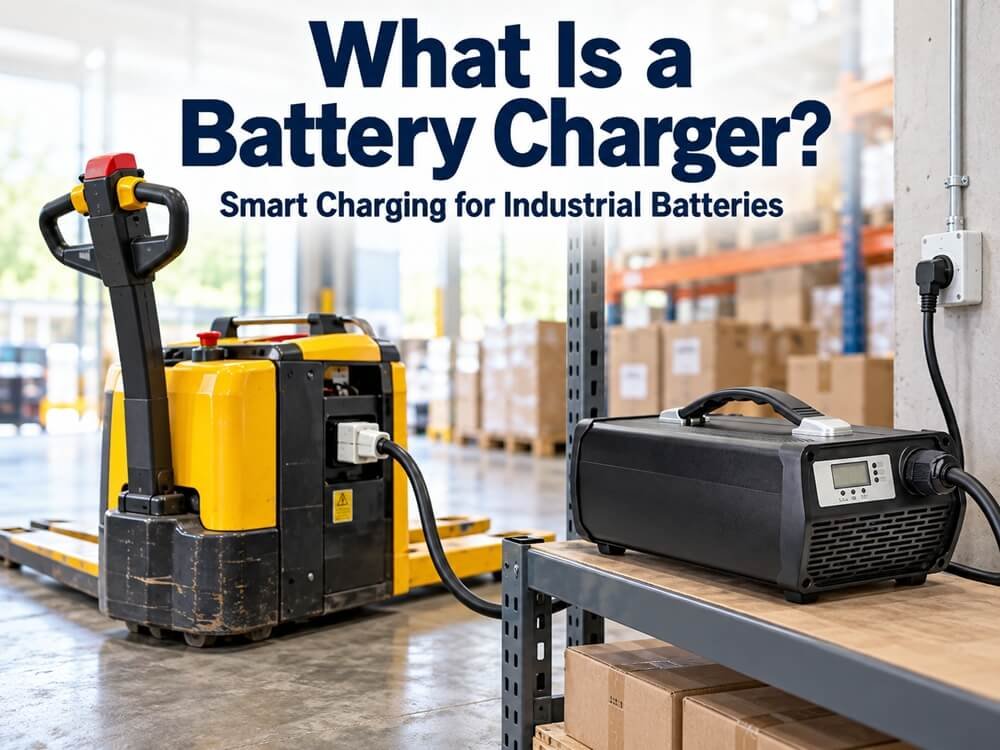
In an era defined by electrification—from autonomous warehouse robots to large-scale energy storage systems—the battery charger has evolved far beyond a simple power brick. It is now the “brain” that ensures operational uptime, battery safety, and long-term return on investment.
In this guide, we explore how modern battery chargers work, the different charger types available, and why industrial-grade smart charging is essential for professional applications.
The Basic Definition: More Than Just Power
At its simplest, a battery charger is a device used to put energy into a rechargeable battery by forcing an electric current through it.
However, unlike a standard power adapter that delivers a fixed output, a modern smart battery charger continuously monitors voltage, current, and temperature, dynamically adjusting the charging profile based on battery chemistry—such as Lithium-ion, LiFePO₄, or Lead-acid.
This adaptive control is critical for preventing overcharge, minimizing thermal stress, and maximizing battery lifespan in professional systems.
How Does a Battery Charger Work? (The 3-Stage Charging Process)
Professional chargers used in Robotics (AMR), E-Mobility, and Industrial Equipment typically follow a multi-stage charging algorithm designed to balance speed, safety, and longevity.
Constant Current (CC) Phase
The charger delivers a steady current while voltage rises, rapidly charging the battery to approximately 80% capacity.
Constant Voltage (CV) Phase
Once the battery reaches its maximum voltage, the charger maintains that voltage while current gradually decreases—ensuring the battery is fully charged without overheating.
Termination / Float Phase
Charging is safely stopped or reduced to a minimal current to prevent overcharge and extend battery life.
This algorithm is fundamental to lithium battery systems used in robotics, forklifts, and automated logistics equipment.
Why Industrial Applications Require Smart Chargers
In B2B environments, consumer-grade chargers are not just inefficient—they can become system liabilities. A true industrial-grade battery charger is defined by the following characteristics:
Intelligence & BMS Communication
Modern industrial systems require chargers to communicate directly with the Battery Management System (BMS) via interfaces such as CANbus, RS485, or UART.
If a cell overheats or voltage exceeds safe limits, the charger immediately reduces output or shuts down—preventing failures and safety incidents.
Efficiency & Thermal Management
In high-power charging environments, heat is the enemy. High-efficiency chargers (typically >92–94%) minimize power loss and thermal stress.
Features such as active fan cooling allow continuous 24/7 operation without performance degradation.
Durability & Protection
Industrial chargers must withstand dust, vibration, and electrical stress. Advanced protection functions—OCP, OVP, short-circuit, reverse polarity, anti-spark—are essential for equipment safety and system reliability.
Real-World Example: AiecoPower 900W Industrial Battery Charger
To illustrate what an industrial-grade charger looks like in practice, consider the AiecoPower AP-FN900AD, a 900W high-power lithium battery charger widely deployed in electric forklifts and autonomous food-delivery robots.
Key Specifications (AP-FN900AD)
- Input: 100–240VAC, 47/63Hz, 10A
- Output Voltage: 12–90VDC
- Output Current: 0.1–55.0A
- Maximum Power: 900W
- Efficiency: >92% @ 230VAC full load
- Power Factor: 0.95
- Cooling: Active fan cooling
- No-Load Power: < 0.075W
- Operating Temperature: -20°C to 40°C
- Protections: OCP, OVP, short-circuit, reverse polarity, anti-spark, anti-reverse current
- Certifications: ETL, CE, PSE, RCM, SAA, CQC
- Safety Standards: EN 60335-1 / EN 60335-2-29 / UL 1012
- Warranty: 2 Years
Why It Matters in Electric Forklifts & Delivery Robots
In electric forklifts, charging downtime directly impacts warehouse throughput. The AP-FN900AD’s wide output range (12–90V) and high current capability (up to 55A) allow fast, stable charging of large lithium battery packs, ensuring high availability for 24/7 logistics operations.
In food-delivery and service robots, charging reliability and safety are mission-critical. Features such as anti-spark protection, reverse polarity protection, and real-time current control protect both batteries and onboard electronics—while high efficiency reduces heat in compact charging stations.This is a clear example of how industrial chargers go beyond basic power delivery, becoming an integrated part of the system’s safety, uptime, and lifecycle management.
Conclusion: The Foundation of Power, Safety, and ROI
A battery charger is not just a peripheral—it is the heartbeat of your mobile equipment or automation system.
Choosing a high-quality, intelligent charger protects your battery, stabilizes system performance, and safeguards your long-term investment.