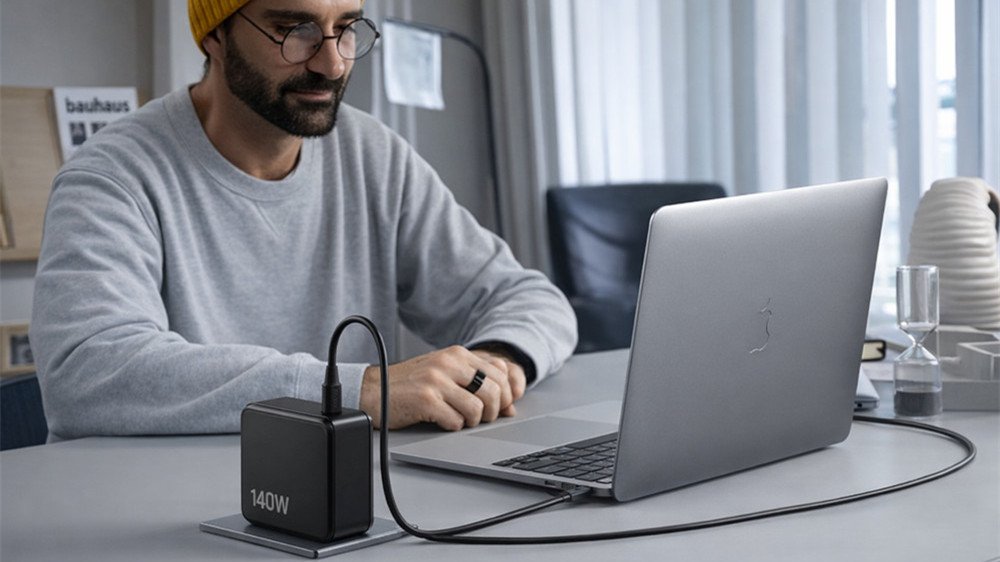
Choosing the right MacBook Pro charger is more than a matter of convenience. Charger wattage directly affects charging speed, system stability, and long-term device reliability. Yet many users still assume that any USB-C charger will work—or that wattage only matters for fast charging.
At AiecoPower, we design and evaluate power solutions for professional devices every day. One thing is clear: understanding MacBook Pro charger wattage helps users charge faster, work more efficiently, and avoid common power-related issues.
This guide explains how charger wattage works, how different MacBook Pro models vary in power demand, and how to choose a charger that balances performance, compatibility, safety, and portability.
Why Charger Wattage Matters for MacBook Pro
Charger wattage defines the maximum power a charger can deliver. For MacBook Pro users, wattage plays a critical role in determining charging speed and whether the device can maintain battery levels during active use.
A low-wattage charger may be able to charge a MacBook Pro when the system is idle, but it often falls behind when the laptop is under load—such as during video editing, software development, or when driving external displays. In these situations, users may experience slow charging or even battery drain while plugged in.
A properly rated power adapter ensures stable power delivery across both light and heavy workloads, enabling consistent performance and a better overall charging experience.
MacBook Pro Charger Wattage by Model and Usage
Different Models, Different Power Requirements
Not all MacBook Pro models are designed with the same power needs. Screen size, processor configuration, and expected workloads all influence Apple’s recommended charger wattage.
Smaller or entry-level models generally require less power, while larger, high-performance MacBook Pro systems demand significantly higher wattage—especially in professional use cases. This difference becomes more noticeable in real-world scenarios where charging and heavy usage occur simultaneously.
Why Real-World Usage Often Exceeds Minimum Requirements
Apple’s recommended wattage represents a baseline. In practice, power demand fluctuates constantly. When workloads increase, chargers that only meet the minimum requirement may struggle to keep up.
This is why many professionals prefer chargers with additional wattage headroom. Extra capacity allows the system to maintain optimal charging speed even during peak usage, improving efficiency and reducing power-related interruptions.
Is Using a Higher-Wattage Charger Safe?
A common concern among MacBook Pro users is whether using a charger with higher wattage than officially recommended could damage the device. In normal conditions, the answer is no—provided the charger is properly engineered and fully compatible.
Modern MacBook Pro models use intelligent power negotiation through USB-C or MagSafe. The device only draws the power it needs, regardless of the charger’s maximum output. A higher-wattage charger does not force excess power into the system; it simply provides more available capacity.
This additional margin enables fast charging when supported and ensures stable power delivery during demanding tasks. From an engineering standpoint, operating below a charger’s maximum output can also reduce thermal stress, contributing to long-term reliability.
USB-C vs MagSafe: Why Compatibility Is Critical
Both USB-C and MagSafe are capable of delivering high-power charging for MacBook Pro. However, charging performance depends less on the connector type and more on compatibility with power delivery protocols.
A charger may advertise high wattage but still fail to deliver optimal performance if it does not fully support the required negotiation standards. Incomplete protocol support can lead to reduced charging speed, inconsistent behavior, or failure to activate fast charging.
This is why charger design must consider more than output rating alone. True compatibility requires accurate power negotiation, stable voltage regulation, and comprehensive safety protections to ensure reliable performance across different MacBook Pro models.
Original vs Third-Party MacBook Pro Chargers
Apple’s original chargers offer guaranteed compatibility, but they are not always the most flexible option—particularly for users who value portability, multi-device charging, or higher power density.
High-quality third-party chargers have evolved significantly in recent years. Advances in power electronics allow modern chargers to deliver higher wattage in smaller, more travel-friendly designs without compromising safety or efficiency.
For many users, a well-designed third-party MacBook Pro charger provides a practical balance between charging speed, compatibility, safety, and portability, especially in professional or mobile work environments.
How to Choose the Right MacBook Pro Charger
When selecting a charger, wattage should be considered alongside several other key factors:
- Charger Wattage – Determines charging speed and performance under load
- Model Compatibility – Different MacBook Pro models require different power levels
- Fast Charging Support – Requires both sufficient wattage and correct protocol support
- Safety Protections – Including over-current, over-voltage, and thermal protection
- Portability – Important for daily carry and business travel
Understanding these elements together allows users to evaluate any MacBook Pro charger, whether original or third-party, with confidence.
Conclusion
Choosing the right MacBook Pro charger is about more than matching a number on a spec sheet. Charger wattage, compatibility, and safety all work together to determine real-world charging performance.
By understanding how MacBook Pro charger wattage affects charging speed, and why proper USB-C / MagSafe compatibility matters, users can make informed decisions that support both productivity and device longevity.
A well-engineered charger doesn’t just power your MacBook Pro—it supports the way you work.